
“Self-drilling” and “self-tapping” are two of the most commonly confused terms in the construction fastener world. They are often used interchangeably, but they describe different point types designed for different applications. Choosing the wrong one can mean stripped holes and poor pull-out resistance.
To help you choose the right roofing fastener, let’s look at the difference between self-tapping and self-drilling screws, when to use them, and common mistakes that can result in damaged construction materials and unreliable joints.
What Are Self-Tapping Screws?
A self-tapping roofing fastener creates its own threads as it’s driven into a pre-drilled or pre-punched hole. The hole already exists, and the screw forms or cuts threads in the substrate to create a secure connection.
Self-tapping screws fall into two broad categories based on how they create threads:
- Thread-forming screws displace material without removing it. They push the substrate metal outward as threads engage, and the displaced material adds to the fastener’s holding power. Construction fasteners that form threads work well in softer metals and thinner gauges.
- Thread-cutting screws have cutting edges that remove material as the screw drives in, similar to how a tap works. They’re better suited for harder substrates and heavier gauges, where thread forming would require excessive torque.
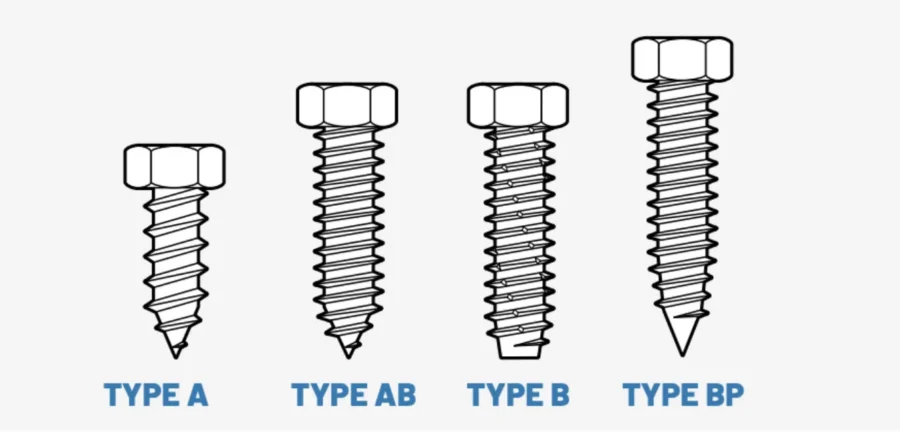
Common self-tapping point types include:
- Type A: A sharp point with coarse threads, designed for thinner materials and sheet metal.
- Type AB: A sharp point with finer threads for better grip in a wider range of material thicknesses.
- Type B: A blunt point with fluted threads for heavier-gauge material.
- Type BP: Similar to Type B but with a cone point that helps locate the fastener in the hole.
When to Use Self-Tapping Screws
Self-tapping screws are the right choice when working with pre-drilled or pre-punched holes. They’re also preferred in corrosive environments: 304 stainless steel roofing fasteners resist corrosion but cannot be hardened sufficiently for a self-drilling tip.
What Are Self-Drilling Screws?
A self-drilling roofing fastener has a drill-bit-shaped tip that creates its own hole. Like self-tapping screws, these fasteners tap their own threads. Workers can install them in a single driving step in materials without a pilot hole.
Self-drilling fastener points are rated by size, typically #1 through #5, with each number indicating the thickness of steel the point can drill through. A #1 point handles light-gauge sheet metal, while a #5 can penetrate heavier structural steel.
Be sure to match the point size to the substrate thickness: too small a point and the screw won’t fully penetrate the substrate before the threads engage; too large and the point may drill through without the threads gripping properly.
When to Use Self-Drilling Screws
Self-drilling screws are the standard for metal-to-metal applications in roofing and metal building construction, including attaching panels to steel purlins and securing trim and flashing to steel framing. Any application where the screw has to penetrate steel without a pre-drilled hole calls for a self-drilling point.
Atlas’ metal-to-metal fastener line includes self-drilling options engineered for a range of substrates and steel gauges. For projects where fastener longevity needs to match the expected service life of the panels, the Metal Ultimate range features a Zamak-5 zinc alloy cast head warranted against red rust for the life of the building.
Common Mistakes When Selecting Point Types
Using the Wrong Point Type for the Substrate
Driving a self-tapping screw into steel without a pilot hole typically results in a damaged point and inadequate thread engagement. In the other direction, using a self-drilling screw when a pre-drilled hole already exists is wasteful, and it can cause the screw to overdrive or spin in the hole without seating correctly.
Mismatching Drill Point Size to Material Thickness
A drill point rated for thinner steel won’t work with a heavy-gauge purlin. It will get stuck and leave you with a screw that’s not fully seated and can be difficult to remove. In contrast, an oversized point on thin steel can strip through the substrate before the threads engage, leaving almost no pull-out resistance.
Both mistakes will result in a fastener connection that is more likely to fail under wind uplift or structural load.
Overlooking How Point Type Affects Sealing
Point type affects more than installation speed. A screw that doesn’t seat properly in the substrate won’t compress the EPDM sealing washer to the correct tension, which can result in water infiltration and accelerated corrosion.
Order the Right Roofing Fasteners for the Job
Choosing between self-tapping and self-drilling roofing fasteners comes down to one question: Do you need the screw to drill its own hole, or is there already one in place? Once that’s answered, matching the point size to the substrate thickness ensures a fastener connection that holds and seals for the long term.
Explore our full range of metal-to-metal fasteners or contact our team for help selecting the right point type for your next project.
